Since 2015, the Young Talent Competition allows discovering the next generation of most talented young watchmakers in the world, supports them in their route to independence by identifying their achievements and putting them under the spotlight. F.P.Journe organises the Young Talent Competition with the support of The Hour Glass, luxury watch retailer in the Asia Pacific region. Both Maisons aim to perpetuate and support the art of haute horology and cultivate the appreciation of extensive horological craftsmanship.
The selection criteria are based on technical achievement, the search for complexity in their realisation, the quality of craftsmanship as well as their sense of design and aesthetics. Applicants must have independently designed and created a timepiece or an horological construction. The 2026 Young Talent Competition winner receives a diploma and a CHF 50,000.- grant from The Hour Glass and F.P.Journe, which will allow him to purchase watchmaking tools or finance an horological project.
Shin Ohno, 27, a graduate of the National Institute of Technology, Toyota College in Japan, won the 2026 edition with his creation, “Fuyu-Geshiki”. He received his prize from Michael Tay, Managing Director of The Hour Glass, and François-Paul Journe during a reception at the Manufacture, in the presence of jury members and former winners who came to support him and share their experiences.
Inspired by the winter landscape of Nagano, his piece brings together a grande and petite sonnerie, a quarter repeater and a tourbillon. Shin Ohno personally carried out the entire development process, from designing the movement to manufacturing the components in his workshop, without using a base movement. The strength of this creation lies as much in its high level of technical demand as in the clarity of its intention, expressed through the architecture of the movement, the work on the acoustics, and the care devoted to the materials and finishes.
The jury of the Young Talent Competition 2026 is composed of key personalities from the international horological scene: Andreas Strehler, Giulio Papi, Marc Jenni, Michael Tay, Elizabeth Doerr and François-Paul Journe.
Shin Ohno
Fuyu-Geshiki (Winter Landscape)
27 years old, Matsumoto, Nagano, Japan
Graduate of the National Institute of Technology, Toyota College, Japan - March 2020
Introduction_
A simple glance at a landscape through a window can instantly calm and soothe the mind. It is this sense of tranquillity that I seek to bring into my watchmaking creations. This piece is inspired by the winter landscape of Nagano, where I live. Surrounded by mountains, this region is defined by the purity of its air, by the flow of spring water, and by melting snow. I chose to express this landscape through a grande and petite sonnerie, a quarter repeater, and a tourbillon. To me, the acoustic complications evoke the sounds of moving water, while the tourbillon suggests the continuous course of a stream. Sound and motion thus come together to form a living whole.
Training and background_
I acquired the theoretical foundations of mechanical watchmaking and design during my work as an engineer at Seiko Epson Corporation, at the Micro Artist Studio. At the same time, I attended advanced technical training programmes organised by Nagano Prefecture, one of the major centres of the Japanese watch industry, in order to deepen my practical skills, particularly in repair work. Since my work within the company was mainly focused on computer-aided design, I had no opportunity there to learn component manufacturing in a practical way. I therefore had to acquire these techniques by myself, by contacting teachers from Japanese watchmaking schools and studying videos on YouTube. I continue to learn, day after day. Among the people who have played an important role in my development, I would mention Masahiro Kikuno, whose path I discovered in a television documentary when I was a child, Norifumi Seki, winner of the Young Talent Competition 2020, and Ikukiyo Komatsu, who guided me during technical seminars in Nagano and transmitted to me not only fundamental skills, but also a true philosophy of the watchmaker’s craft.
Development of the project_
This project required around eleven months of work. I devoted the first two months to research and documentation on striking mechanisms. The following four months were dedicated to design, and the next four to manufacturing the components. The final month was then devoted to stabilising the striking mechanism and refining its sound. I developed this piece alongside my professional activity, which was the greatest challenge of the project. I woke up at 5 a.m. to work on it for two hours before going to the office, then returned to my bench from 7 p.m. until midnight every evening. All of my weekends were devoted to it as well. The project evolved considerably from my initial idea. At first, in order to meet the one-year deadline, I had imagined a simpler piece, with only a petite sonnerie. But as the project progressed, I felt that a work conceived through compromise had no true value. I therefore decided to push beyond my own limits and significantly enrich its specifications. This choice led me to adopt a very rigorous way of life, but I do not regret it.
Aesthetic expression_
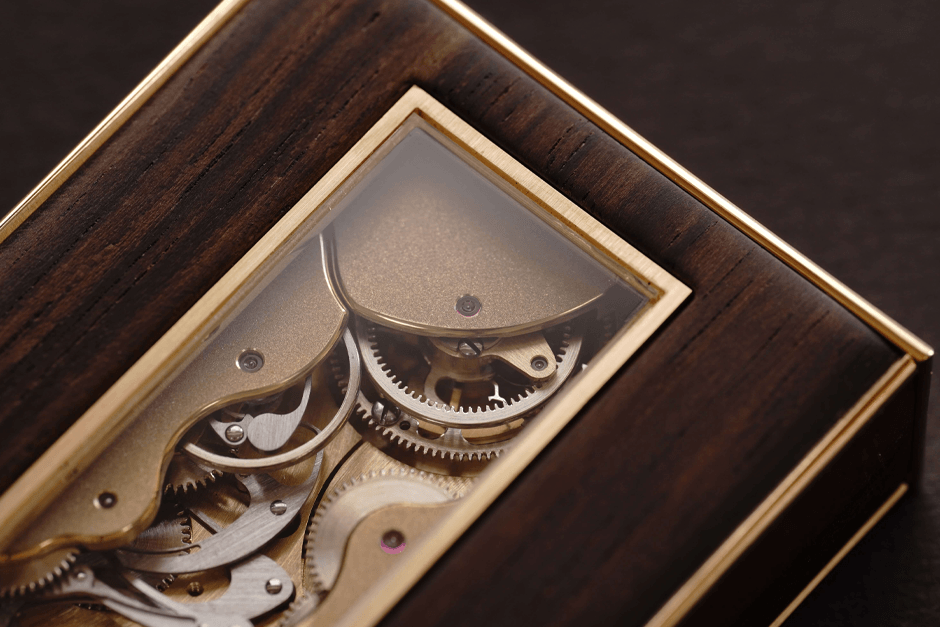
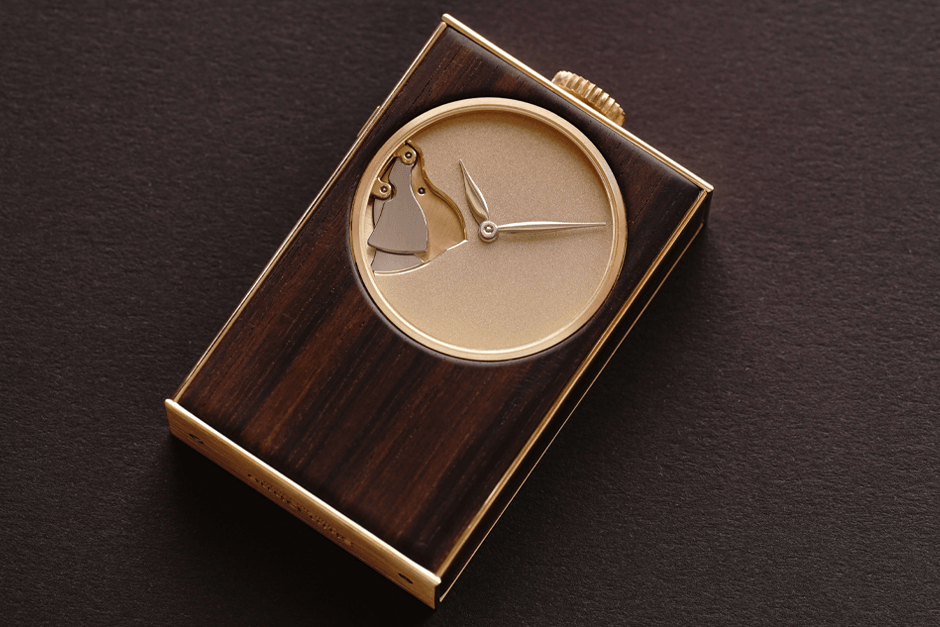
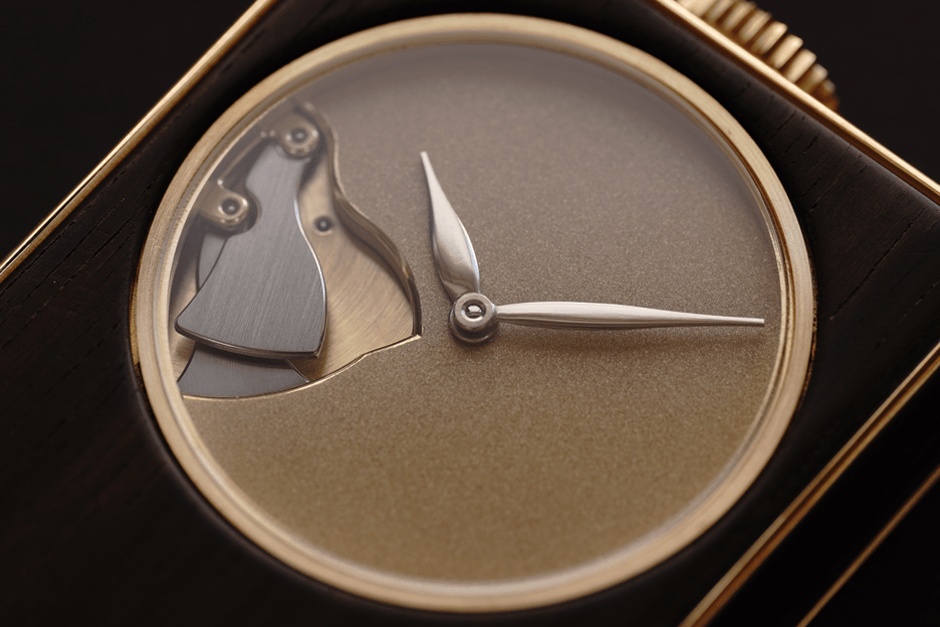
Through the design of this piece, I wanted to evoke the experience of a winter landscape observed from indoors, through a window. The ebony and brass case acts as a frame, heightening the contrast between the interior space and the scene unfolding before the eyes. The dial and the movement are built around three main themes: the texture of snow and water, the shimmer of the stream, and the dynamics of the landscape. To express the softness and light-diffusing quality of snow, I applied a frosted finish to the dial and bridges, obtained by emery blasting. By contrast, the wheels and plates are given a satin finish intended to evoke the steady flow of water. To recreate the way sunlight reflects on the surface of a stream, I hand-polished the tips of the wheel teeth one by one until they reached a mirror polish. On the dial, the movement of the hammers evokes, to me, branches parting the snow. This movement is highlighted by the contrast between the frosted surface of the dial and the satin finish of the hammers. Their superposition further reinforces the visual depth of the whole.
Watch architecture and technical choices_
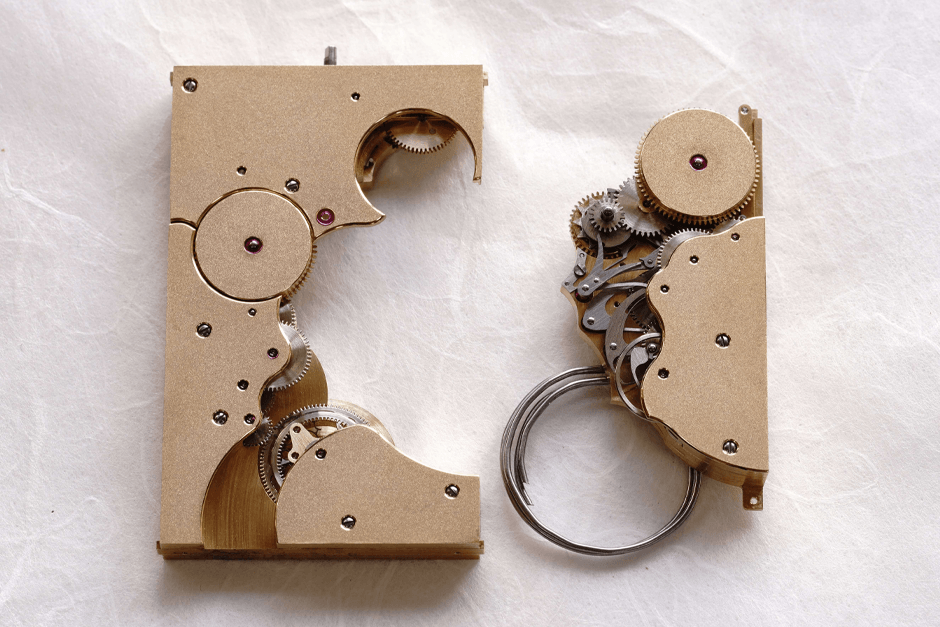
In this piece, I considered the striking mechanism as a central element in the expression of the landscape. For this reason, I conceived its visual composition, serviceability, usability, and reliability as a whole. The striking mechanism, usually hidden beneath the dial, is here positioned on the movement side. This choice creates visual depth and fully integrates the superposition of the components into the overall landscape of the piece. The gongs are made from piano wire, chosen to produce a peaceful sound. The movement also adopts a modular construction separating the timekeeping function from the striking mechanism, allowing each complex mechanism to be adjusted more precisely and more easily. I also wanted to integrate the quarter repeater activation into the crown, without a separate pusher, in order to preserve the purity of the case while allowing simple operation, even when the piece is placed on a desk. Finally, to prevent any mechanical incident, I designed a system that automatically deactivates the striking mechanism when the power reserve becomes too low. Once the mechanism is engaged, a locking device also prevents any pressure from being applied to the crown. This safety system is driven by planetary gears and cams.
Making process and way of working_
I work in a workshop I have installed in the largest room of my flat. As neighbours live on the floor below, I am always careful not to make too much noise. I mainly use a desktop CNC machine and a watchmaker’s lathe. My approach is to carry out every stage of the process myself, from design and manufacturing to final adjustment. It is important to me to be able to say that this is truly my own creation. My philosophy also consists in not reproducing existing movements or components. On the contrary, I seek to bring my own interpretation and my own design to every element. With the exception of the rubies, ball bearings, crystal, mainsprings, and hairspring, every component was designed and manufactured in my own workshop. There is therefore no base movement. The project developed in several stages: defining what I wanted to express through the piece, visualising the overall layout through sketching, then checking the mechanical feasibility in CAD, adapting the component shapes to the real constraints of the tools and machines, manually correcting manufacturing tolerances, disassembling to apply the finishes, reassembling, and then repeating the process as many times as necessary until the desired result was achieved.
Materials, finishes, and adjustment_
The case is made of ebony and brass. The bridges are in brass, the wheels and hands in German silver, while the hammers, levers, and springs are in steel. The greatest technical difficulty of the project was manufacturing precision. At the centre of the movement, I adopted a construction bringing together on the same axis more than ten different components, including the hour snail cam, quarter snail cam, surprise piece, and star wheel. At first, it did not work at all. The smallest manufacturing errors in each of these components accumulated into a much greater problem. I therefore had to rethink the manufacturing process for each part one by one before achieving stable operation. The other major difficulty concerned the sound. The tone changed completely depending on the movement of the hammers, the way the gongs were fixed, and even their shape. A sound that seemed ideal when the piece was lying on the bench could change as soon as I picked it up in my hand. I therefore had to go through a great many trials in order to stabilise a satisfying sound. I continue this search even today in order to achieve a tone that is as accurate as possible.
Technical specifications_
Name: Fuyu-Geshiki (Winter Landscape)
Dimensions: 59 x 41 x 14 mm
Weight: 122 g
Complications: grande and petite sonnerie, quarter repeater, tourbillon
Power reserve: approximately 50 hours
Total number of components: 395
Case: ebony and brass
Bridges: brass
Wheels and hands: German silver
Hammers, levers, and springs: steel
Gongs: piano wire
Finishes: frosted finish on the dial and bridges obtained by emery blasting, satin finish on the wheels and plates, mirror-polished tips of the wheel teeth
Manufacture: with the exception of the 68 rubies, 11 ball bearings, crystal, 3 mainsprings, and hairspring, all parts were designed and manufactured by Shin Ohno in his workshop, with no base movement.